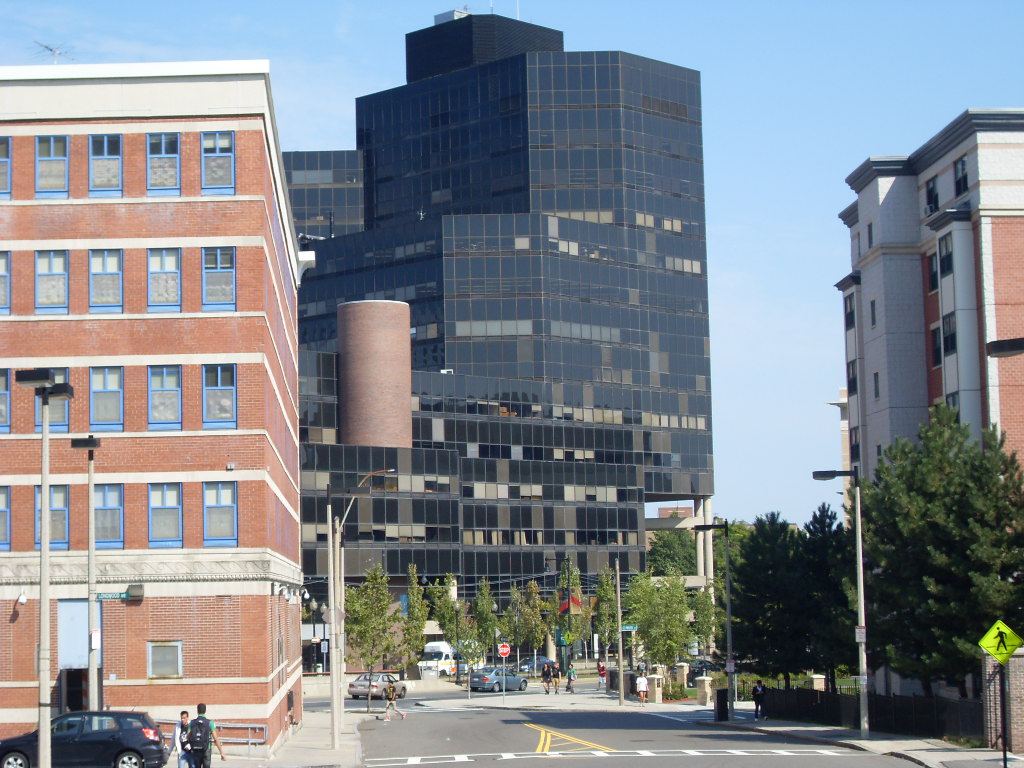
History of Fort Hill, Part 2 (2008). Mural by: Loray McDuffie, Taylor Saintable, Edwin Perez-Clancy, Christine O'Connell, Julia Andreasson, Jorge Benitez, Divah Payne, Lucy Saintcyr, Laua Dedonato, Gregg Bernstein.

Friday, October 22, 2010

Feline Yin and Yang on Fort Hill

Two of three rescued kittens.
We've buried more than our fair share of stray cats.  It's usually during a harsh winter.  Sometimes it has been after a collision with an automobile in the summer.

It's never pretty.  It's never easy.

In the winter, one has to pick a location, clear the snow, and hope the digging isn't too difficult.  It can be a hard job of work to break up the frozen ground with a pickax or mattock.  Never mind the trouble shoveling through the damned Roxbury rocks.

In the summer, the grave has to be dug deep enough to discourage Nature's  recycling scavengers from picking up the scent, digging up the carcass, and settling down to a tasty, foetid bite to eat.

In summer or in winter, after rigor mortis has set in, it is hard to sensitively balance respect for the remains of the deceased cat with digging a reasonably sized hole for the grave. In the absence of rubber gloves, and in a howling wind, fitting the furry body into the too-small hole using only the business end of a shovel...is...well, emotionally taxing.

As we said, it's never pretty; it's never easy. And, we always hate it.

So, when Mother Cat and her litter of three kittens showed up on our porch, it seemed necessary to do the right thing.  To treat with respect the feline co-inhabitants of our little square of green space in the city.  To reduce the chances of another mid-winter burial.

And, to return thanks for the colony's work to thin out the verminous squirrel population:  three carcasses, and counting.

Saturday, October 2, 2010

It's a Zoo on Fort Hill


A couple of comments at UniversalHub tell us that it's a Zoo on Fort Hill, with raccoons and skunks.  We've seen opossums, too.

And cats.  Feral cats.

A jet black mother cat was zonked out on the back porch the day before yesterday afternoon.  She had three rambunctious kittens who were alternately nursing and batting at the foliage being driven to and fro in the strong winds.  The mother was so sound asleep that we were able to approach within three feet to set down tuna and a water bowl.

By the time we returned with dry food and the camera, the mother cat was up and about, hissing and walking to the other end of the porch, attempting to draw our attention away from her litter.

Wanting to be responsible fellow urban mammals, we withdrew to watch.  Holy moley.  Nursing cats need a lot of food, for Mother Cat inhaled the tuna and then went to work with a vengeance, wolfing down the dry food.

Graduating from urban mammal to responsible urban citizens and thinking that three more fertile cats were not the best demographic addition to the neighborhood, we consulted the internet to see what we could read about feral cats.

Perhaps we could squeeze out a low-effort post to Jonas Prang, decorated with a few shameless kitty pics.  Hopefully we could figure out what to do about these cursorial carnivores.  (And, perhaps take our minds off yet more human carnage in Roxbury.)

After two hours of reading, we put the hope of a low-effort post to rest.  And, the hope of low-effort action to do the right thing by these...well...kitties.

TNR:  Trap, neuter, and return [ASPCA web site] seems to be the fashionable response to feral cats.  Trap and kill—the run-of-the-mill response to vermin—causes a vacuum effect.  Destroying a stable feral population merely invites new feline neighbors to move in to replaced the ones recently slaughtered.

A modest amount of googling for feral cats yields a stunning amount to read.  In an American society besotted with dogs and cats, why were we surprised?

So, to conclude this post we will provide just one more shameless kitty pic of our new neighbors.  And, we'll give a lightly annotated list of pages that seem useful for learning what to do about feral cats.


  • Commonwealth Cats, with a Peabody mailing address, may be what we need if we can bestir ourselves to trap this mom and her kits.
  • The resources page at Commonwealth Cats yields a link to the band-width-heavy web site of Alley Cat Allies a 501(c)3 organization with $4 million annual budget and net assets of $2.8M.  Perhaps they would make a small contribution so Jonas Prang can get these cats neutered.  We have to give them credit, though, for they make it easy to read their annual reports from FY 2003 to FY 2009. [3.4MB pdf]  And, they offer to send you their IRS 990, useful to see how 501(c)3s are overpaying their executive staff.
  • Drop Trap Design is a blog that tells how to build and operate a drop trap.  It also tells that cats are apparently so stupid that one can trap them over and over and over again, and they never catch on to the scheme.
  • Neighborhood Cats is pleased with its design for Tomahawk's Feral Cat Trap.
  • There is the sweetly-named, local, Jamaica Plain HubCats, though this site hasn't been updated since March 2008.
  • Here is STOP Clinic (Stop the Overpopulation of Pets), operated out of Weymouth.
  • And finally, there is the inevitable Wikipedia article on feral cats
Oh, and one more thing:  It seems mother cat has her own trap 'n' kill program, for skin and bones laid out just a few cat steps from the nursing cat are all that remain of one of the resident squirrels.

Make that trap 'n' kill 'n' eat.
Two days later, the bones are gone and only the pelt remains.

Friday, October 1, 2010

Refuge Church of Christ

The former Fellowes Atheneum in March 2010.
The Refuge Church of Christ at 46 Millmont Street, opposite the Lambert Playground, has a new (to us) sign out front.

The sign announces that the church has received a matching emergency grant from the Massachusetts Preservation Projects Fund. The recipients and amounts from the current grant round 16 (Award selection June 9, 2010) have not been posted to their web site.

Other grant recipients in Roxbury from this fund have been the Roxbury Presbyterian Church (round 11) and Hibernian Hall (round 10).

The National Trust for Historic Preservation made a $5,000 grant [page 14 of a 44-page pdf] to the Refuge Church of Christ in their fiscal year 2009.

Beyond the pestilential aggregator advertising sites, the Refuge Church of Christ has no web presence.  Their fundraising consultant Jillian Adams, Building Legacy, features a picture on her web page and displays a short testimonial quote on her Results page.

The comprehensive Emmanuel Gospel Center Church Directory does provide a telephone number and an impressive list of personnel for the Refuge Church: Bishop R Lawson (founder), Bishop Theodore Hester Sr, Rachel Adams (Secretary), and Jo-Ann Gay (Secretary).

McGinley Kalsow of Somerville is listed on the sign as the preservation architect.  It appears this is their second project in Roxbury after the Shirley-Eustis House, and they give several projects in close-by neighborhoods on their impressive portfolios page:  the Union United Methodist Church in the South End; St. Brendan's and the former St. Margaret's in Dorchester; and St. George Cathedral, St. Vincent de Paul, and Gate of Heaven in South Boston.

Jack Aniceto is the masonry contractor.  He has worked on a number of significant local projects and his skill with masonry restoration vastly surpasses the poor quality of his German-based web site.

Refuge Church of Christ Phase 1 Emergency Stabilization.

Tuesday, September 28, 2010

Destinations off the hill: the walking route to Kenmore

Edward M. Kennedy's funeral mass was said 29 August at the Mission Church. In many ways this minor basilica is a much more impressive building from the back than it is from the front.

In an earlier post we sung the praises of Fort Hill's location, briefly listing some of its nearby cultural, educational, and transportation options. Still speaking from the stance of a Fort Hill booster, this post will take a more practical slant and try to take a liability—poor transit options on the NNW to NW of Roxbury Crossing—and turn it into a benefit.

For the most part, the transit options from Fort Hill are particularly fine and varied. The Orange line is excellent for those going NE to the city center or SW to Jamaica Plain. The 19, 22, 23, and 28 buses serve reasonably well for those going S and SE to Dorchester. The 15 and 41 do a decent job when heading due E. At the best times of day the 66 is tolerable going W into Brookline.

But, the MBTA has nothing quick when one is heading N or NNW to the Longwood Medical Area, to the Gardner Museum, to MFA, to the Fens, or to Kenmore.

It is in this direction that the old libel against the T is so true: Should we walk? Or, do we have time to take the T?

When headed NNW, it is always best to walk or to bicycle. And, walking works just fine. Early last week (perhaps on the same day Iseut was collecting an oral history on the Mission Church Grammar School) we headed out to the Kenmore office of Harvard Vanguard Medical Associates. (Via the MBTA, we would have to take the 66 bus and change to the 65. Or, schlep in on the Orange Line, doing a walking transfer at Back Bay-Copley to head back out to Kenmore.)

Here is the route we took:
  • Tremont to Gurney, cut through the vacant lot to Smith, Smith to St. Alphonsus to Huntington.
  • Take the unregulated crosswalk just inbound from Ward Street to avoid waiting at the dangerous light at Longwood.
  • Then head inbound on Huntington to Evans Way and cut through the park to The Fenway.
  • Take either crosswalk over The Fenway (in front the Gardner Museum or further up in front of Simmons) and descend to the level of the Muddy River (see the great field of daffodils in the springtime).
  • Rise up from the river at Park Drive, taking your life into your hands at the crosswalks there.
  • Pass through the Field of Geese under which the Muddy River is buried.
  • Cross over to the north side of Park Drive at the crosswalk.
  • Then it's a straight shot through the snarling intersection at Boylston and up Brookline to Harvard Vanguard.
With one twiddle, Google figures it to be 28 minutes; we walked it in 20 with five minutes to cool down. (Google wants you to take Parker Street to Ruggles, when the back way up Smith Street is a much nicer walk.)

Walking this route is not only a practical mode to reach an appointment in Kenmore, but it is also an interesting walk. Here is a handful of briefly annotated photographs depicting what can be seen along this route as far as Isabella Gardner's unfortunate backyard.

The Maurice J. Tobin School is easy to miss, hidden behind the shade trees on Smith Street. This mural is seen from the playing fields on the east side of the school.


Not the best looking side of St. Alphonus Hall, as seen from the same playing field. At least it's been properly boarded up with plywood painted to match the stone. The worthies at RCC should take notice.

One hopes that this sign can be preserved. As few as five years ago, the internet was bereft of any hits for Pilate's Daughter; it was all Pilates all the time. Now Google yields a fair amount of notice for the search string. Perhaps John Clifford could tell us something from a first-hand perspective.

Every spring, the management company at Mission Main plants what becomes a tsunami of impatiens by season's end. The begonias don't do too badly either.

Devotion to Our Lady is laudably strong on Smith Street, with at least three effigies—but no blue bathtubs. The less laudable inflatable pumpkins, reindeer, and Santa Clauses are due to erupt anytime now. Chacun à son goût.

A view of the "new", formerly infamous Boston State College building viewed from St. Alphonsus Street. A middling building of its kind, we're hoping that auditorium is working out for MassArt, it's current occupants.


The former site of a grifty little gas station at the corner of Ward and St. Alphonsus streets, this park is a great improvement.

It's a shame about Isabella's carriage house, but we're hoping the trustees have made the right bet.

Monday, September 27, 2010

Rush Hour Bicycle Census at Columbus & Cedar

1885 Ordinary, with the small wheel in front.  From Patent Pending Blog.
We performed another bicycle census at the intersection of Columbus Avenue and Cedar Street this past Thursday, 23 September 2010 between 5 and 6 pm.  The temperature was in the high 60s, the wind was calm, and the skies were clear.  We posted ourselves on the outbound side of Columbus Avenue just north of Cedar Street.

Our previous census was done on 3 June 2010 from 5:18 to 5:40 pm. We counted on our fingers while waiting for a #22 bus to show up.  We counted 103 bicyclists. This was done over a 22-1/2 minute period, yielding an hourly rate of 275 bicycles/hour.

This time, equipped with paper and pencil, we performed a more deliberate census making tallies for each five-minute interval between 5 and 6 pm.  For both the inbound and outbound directions we counted helmeted and unhelmeted bicyclists, walkers, and runners.

Surprising to us, the hourly rate was  213, a 22% drop from the 3 June count.  Put another way, in the 25 minute interval between 5:15 and 5:40—approximately the same time period of the June count—there were only 95 bicycles compared with 103 in 22-1/2 minutes.

One oughtn't generalize from only two counts, but we would have thought that with the students back in town there would have been more bicyclists, not fewer.

Here is a summary of the results for bicycles:

BicyclesHelmetedUnhelmetedTotal
Inbound152641
Outbound13240172
Total14766213

And for Pedestrians:

PedestriansWalkersRunnersTotal
Inbound17219
Outbound23326
Total40545

The split between helmeted and unhelmeted bicyclists was 70:30, far different to my guesstimate on 3 June of 95:5.  The split between outbound and inbound bicycle traffic was 81:19, remarkably close to my guesstimate in June.

Another observation is that the unhelmeted inbound riders—going against the homeward commute—exceeded the number of helmeted riders, while outbound the helmeted riders outnumbered the unhelmeted ones by a greater than a 3-to-1 margin.

There was one recumbent bicycle (outbound) and one bicycle rigged for freight (inbound) with an extended frame in the rear.  There were two outbound scooters not included in the count.  The were only two bicyclists traveling in Columbus Avenue proper; they were both inbound and were included in the count.

Bell Biker Bicycle Helmet.  Photo by Melissa Lew from America On the Move.

Saturday, September 25, 2010

Feeling stimulated? Some of ARRA's $787B comes your way

First it was Talbot Avenue, crosswalks, bike lanes, parking strips, and 'adjusting' the Codman Square traffic flow.  Very nice.

Then it was Blue Hill Avenue, done at the beginning of rush hour, that made Morton Street/Rt. 203 an attractive alternate route.  Didn't MLKing Blvd get redone, too?

Now tonight it sounds like Marine One is hovering low, in front of Roxbury Community College.  Our stimulus dollars have arrived circa your house.

The spreader machine with its dump truck tender is surprisingly quiet.  It's the growler in the picture on the bottom (and its mate) that make all the low rumbling noise.

The politicians want you to know that all that American Recovery and Reinvestment Act dough is well spent.  Here's what the Feds have to say.  This is the Commonwealth's take on things.  The City of Boston provides its accounting here.


Friday, September 24, 2010

Moving on: A wistful farewell to the Third Decade

This delightful photograph is from an occasional series TD ran depicting various attempts of too-large-vehicles to slalom down his too-small street.

The Third Decade announced back in June that he was ending his six-year-long affair with blogging and will continue canoodling exclusively with Twitter and Facebook.

More's the pity.

From C'mon, Bush, Talk to the Colored Folk and the continuing saga of Homeownership in 2004 to Boloco and From Filenes to Ferdinand in 2010, it was a good run. And in between, he was eying the cute guys on the Orange Line and sharing ruminations on how the city worked—and didn't work.

We keep checking the blog, hoping TD will change his mind, but that seems not to be in the cards.

It's too bad that TD changed the blog layout with the last post. The elegantly narrow, black and white streetscape is gone, replaced with a vapid green layout. (On what other local blog have we seen that theme?)

Moreover, with the hasty change in layout, the navigation has been broken so that one has to twiddle with the url to get early pages.

And he can't count very well, for his 30s were his fourth decade, not his third.

Sigh. We sound jilted, don't we? Abandoned for the ephemera of tweets and feeds, where it's hard to discriminate between noise and signal.

Third Decade, we'll miss you.